

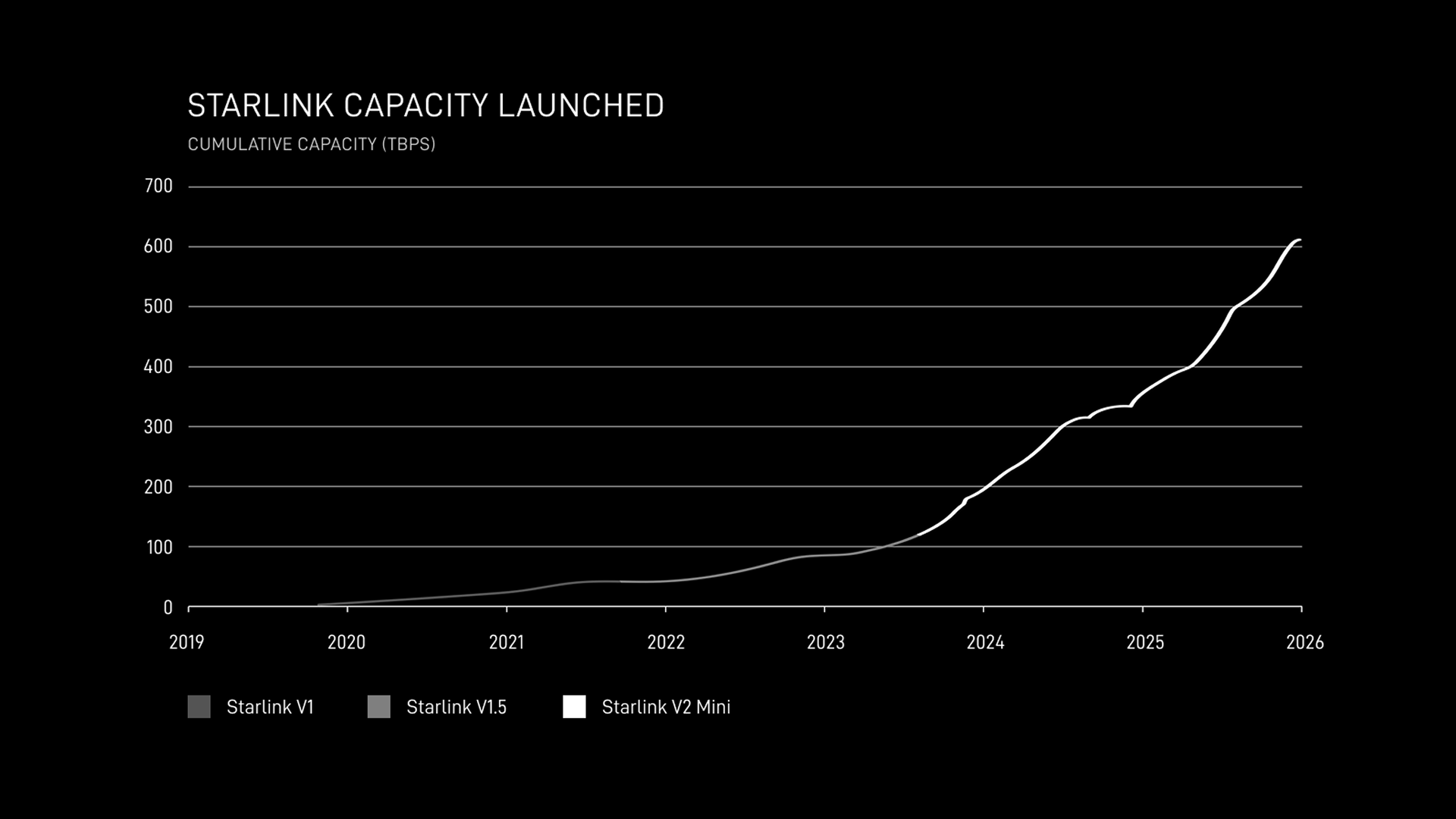
In an extraordinary year for spaceflight and satellite internet deployment, SpaceX achieved a historic milestone in 2025, conducting an unprecedented number of launches to expand the Starlink constellation and meet surging global demand for reliable, high-speed internet. With over 120 Falcon 9 missions dedicated to Starlink deployment, the company added more than 270 terabits per second (Tbps) of network capacity to its rapidly growing broadband satellite network, further solidifying its role as a critical provider of worldwide connectivity.
Starlink’s ambitious deployment strategy reflects a broader effort to bridge the digital divide — delivering broadband where traditional ground-based infrastructure is limited, insufficient, or entirely unavailable. The constellation now supports millions of active subscribers across more than 155 regions worldwide, with the network’s subscriber base nearly doubling in 2025 alone to more than 9 million users.

The expansion in 2025 was fueled by SpaceX’s remarkable launch cadence. For years, SpaceX has iteratively increased its launch tempo using its reusable Falcon 9 rocket, now capable of flying missions nearly every other day — a cadence that has enabled consistent growth of the Starlink constellation. During 2025, more than 120 of these missions were dedicated to deploying Starlink satellites, significantly enhancing the network’s throughput and geographic coverage.
With each Falcon 9 launch carrying a batch of new satellites into low Earth orbit (LEO), the overall capacity of the Starlink megaconstellation increases proportionally. The roughly 270 Tbps of added capacity in 2025 alone represents a meaningful leap in the constellation’s ability to support a growing customer base and expanding applications — from home broadband in underserved regions to in-flight connectivity on commercial airlines and real-time communication networks for ships and remote enterprises.
This capacity growth did not occur in isolation. Starlink’s network architecture integrates thousands of satellites operating in coordinated orbits, supported by terrestrial ground stations and advanced traffic routing systems. Such infrastructure enables low-latency and high-bandwidth connections that compete with or even surpass some traditional broadband technologies. In regions lacking fiber or fixed wireless access, Starlink has proven particularly transformative, enabling populations previously excluded from modern high-speed internet to participate in the global digital economy.
The benefits of Starlink’s expanded capacity extend beyond consumer internet service. For enterprises operating in remote or mobile environments — including maritime shipping, logistics hubs, and disaster relief operations — increased bandwidth and reliable connectivity unlock new possibilities for real-time data transfer, remote monitoring, and cloud-based communications. Educational and healthcare applications also stand to benefit from broader, more consistent connectivity in underserved areas.
SpaceX’s sustained launch rate in 2025 also highlights the company’s broader capacity to innovate in rocket reusability and mission optimization. Falcon 9’s reuse of first-stage boosters has driven down costs and improved launch frequency, enabling this aggressive deployment schedule. Although future rocket systems like Starship may further accelerate satellite deployments, Falcon 9’s performance in 2025 illustrated the viability of repeated, high-cadence space missions as a backbone for global infrastructure expansion.
Looking forward, the momentum established in 2025 sets the stage for continued growth in the satellite internet market. With more countries, industries, and individual users seeking fast, dependable internet access, Starlink’s enlarged capacity and expanding constellation position it to address both current and emerging connectivity challenges. As SpaceX continues its phased deployment, innovations in satellite design, network management, and launch operations are likely to further enhance the constellation’s capabilities.
In summary, the record Falcon 9 launch cadence and the addition of more than 270 Tbps of capacity in 2025 represent major steps in Starlink’s evolution as a global internet network. These achievements not only reflect technological prowess but also contribute to a broader mission of expanding equitable access to high-speed internet everywhere it is needed.


Leave a comment